Books by Sue Burge
Sue Burge is the author of a number of poetry collections and pamphlets published by Live Canon, Hedgehog Poetry Press, and most recently Yaffle Press, who brought out her latest collection watch it slowly fade in 2025. Her work ranges from full-length collections such as Confetti Dancers and The Artificial Parisienne to smaller pamphlets including The Saltwater Diaries and Lumière. Each book reveals a different facet of her writing, whether it is the cinematic lyricism of her debut In the Kingdom of the Shadows, her edgy on-going relationship with Paris, the salt-laced explorations of the Norfolk coast, or the tender yet urgent ecological focus of her newest work.
Here you can browse all of Sue’s publications, read critical praise, and order copies directly.
watch it slowly fade
2025, Yaffle Press, £12.00

Sue Burge’s latest collection, watch it slowly fade, turns a sharp, lyrical gaze on ecological anxiety. These poems ask urgent questions about the fragility of our world, tracing the slow fade of landscapes and species alongside the unease of living through environmental crisis. Combining beauty with loss, this collection speaks to anyone concerned about the future of our planet.
Praise for watch it slowly fade
“Sue Burge has that rare ability to focus closely on her subject matter without ever seeming to intrude. These meticulous poems turn on the fixed elements of the natural world – earth, wind, sea, light and time. They are honest, unflinching and yet uniformly uplifting.”
John Glenday
“Sue Burge is a minutely sensitive observer of natural phenomena; her poems immerse the reader in a world of vividly realised seascapes and saltmarsh, storms and sunlight… Part celebration, part ecological warning knell, part elegy.”
Sarah Doyle
Read sample poems from watch it slowly fade
water is thinking
about the smallest fish —
how its breath contains air
no bigger than a pinprick

is thinking that sometimes
it cannot save the starfish stranded
on the shore
          despite its frantic lapping —
          a desperate hand that can’t quite reach
          a drowning man

water wonders why it cannot cry

tries not to overthink
but notices it’s easier to rise these days
perhaps something is shifting

it remembers the ice that stilled its surface
how it still holds the meltwater
of that ancient mitosis

water scrawls messages on the sand
hopes they will soon be understood
water thinks
                     there is so much of me and oh, they are so small
the trees are talking to themselves
sending messages about the sky
from canopy to root
flirting with sunlight
murmuring rain mantras
in all their dialects
the oaks swearing
at the cloudless sky
in flawless Anglo-Saxon

rough bark tattoos my calves
I have always been in love with silver birches
longing to fall into a Russian fairy-tale
feel snowflakes wet my eyelids
smell the pungent truth of wolves

today is brown and dry as late autumn
I crunch leaves underfoot
a child at play in August’s heat

a stumble of long roots
lichen dapples bark
like tarnished silver
a single note of birdsong
catches in high branches
(Winner of the Norfolk Prize, Café Writers Competition 2022)
Temple of Fame
Studley Royal Water Gardens
Studley Royal Water Gardens
When they peeled the dome
from the damaged temple

it was full of honey, oozing
down the columns like candlewax

the workmen’s hands slathered
as if they were desperate bears

just out of hibernation;
legacy of the monastic bees

who’d swarmed in trees
since the Dissolution.

Imagine them one day
sliding under the dome

not caring about the fakery
of painted marble, hollow columns

the notion of fame;
doing a crazy little charleston

for their fellow bees:
Come, come, we have found a city.

This poem appeared on The Friday Poem, 10 June 2022
The Artificial Parisienne
2024, Live Canon, £12.00
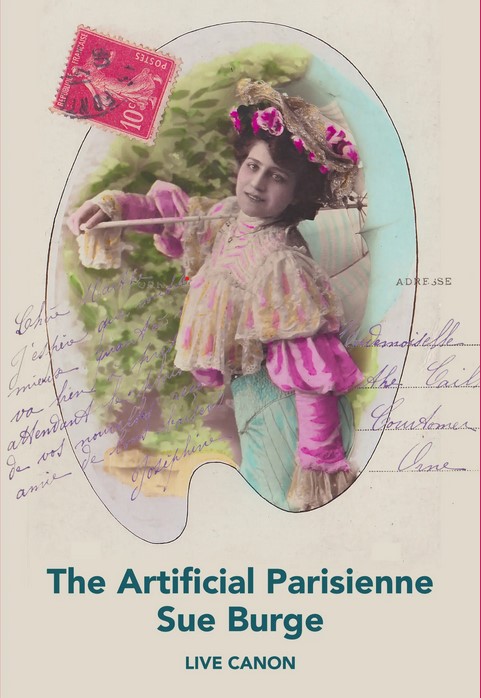
Praise for The Artificial Parisienne
“Sue Burge’s skylark shout of yes yes yes to Paris is no mere tourist crush. All honesty, by way of the Nouvelle Vague, couch-surfing, Oulipo, and the bouquinistes, Burge examines her long-term flawed affair with the City of Light, unravelling its urban celluloid distortions like a shifty-eyed Seine siren, leaving wet lipstick kisses all over town. We can’t help but want to follow her trail.”
Lisa Pasold
“Here are the many recipes for Paris, that ‘fickle madame blowing lipstick in your eyes’. In this collection, its bread, calentica and every one of its clichés are made new by lifelong visitor, Sue Burge. Her poems entice with their range and invention as she explores the city, its characters, history and her place in it. There’s Thanksgiving dinner at Gertrude Stein’s, Kurt Cobain at Père Lachaise, Sacré Coeur gleaming like salt in moonlight, and absinthe that looks like liquid peridot and curiously tastes like childhood. Burge may style herself ‘The Artificial Parisienne’, but her Paris will never be a cardigan.”
Kate Noakes
Read sample poems from The Artificial Parisienne
I am building Paris in my bedroom
								First, I cut a string of paper dolls from a back-copy of Le Monde - such a city needs a population of a certain kind of girl.  Here’s one who arrived in Paris for the first time, shiny, innocent, and left with je ne sais quoi and a fringe like Juliette Greco.

I am building Paris in my bedroom.   From leftover lego I snap Notre Dame into higgledy shape, balance a flimsy girl on the Quai aux Fleurs.  She easily answers the question Where were you when…? for she is always in Paris when someone famous dies. She will speak of the friend who died with unwritten dances still inside, how she sat in shock in her Bastille flat, brim with unwept tears.

In my dreams I’m lost in Montreuil’s labyrinthine murs á pêches, hands a mess of clawed juice, crushed kernel or I’m deep in the catacombs - conducting a pyramid of skulls grinning dusty harmonies to regretful songs.

I am building Paris in my bedroom.  See, here’s the Eiffel Tower fashioned from a cat’s cradle lifted from my lover’s fingers in 1981.  Today I plan to craft the silhouette of Sacré Coeur, tear off a wavering girl to place on the steps.  She’s a girl who had a doll’s house but no idea of home; a girl who thinks she sees angels, bought a penny string of beads and named them rosary.  A girl who looked for love in a scavenged prayerbook.

I am building Paris in my bedroom.  Look, I’ll put a girl here on Pont St Michel cupping the silk of the Seine like a sacrament to fill her home with light, Gallic shrugs, the joyful lather of French soap, unexpected brioche crumbs between the sofa cushions.  This girl knows she’s a cliché in her belted mac, angled beret, quick slick of rouge allure; some days she is noir to her soul – resistez, resistez!  A girl can be too cool you know, instead of strutting the streets as if she belongs she should kiss the platform of the Gare du Nord, ecstatic, papal.

I am building Paris in my bedroom.  Here are the chaotic market stalls of Barbès clustered under my bed. I fashion them the old way with matchsticks and twine, colour in polystyrene food with felt-tip pens.  The trick is to not want to be somewhere else, not to crave the cracked skin of a perfect baguette.  This girl, this girl, when she tries to speak her mouth is dry with the rust of unsaid vowels.
This poem appeared in the 2021 Live Canon Poetry Prize Anthology
A reverse abecedarian in praise of Paris
this city is a jazz riff high as a skylark shouting yes yes yes to April this city is an expletive on the webby wad of your tongue it is not a valentine’s card or a passive verb this city is a crucible for umbrellas a tender prism a slow dance with no stoplights this city is retrofitted with cobbles and revolutionary baguettes this city is acquisitive and pronounceable a psycho-geographic love letter this city is overused a never-ending mosquito bite saying look at my lovely toys all spire and steeple and dome this city thinks it’s a kingdom will make a jumble sale of your heart is an implausible impetuous impinger of your dreams this city is held in the hands of saints an unshareable galette des rois it’s a fickle flirty madame blowing lipstick in your eyes this city is a raised eyebrow a dust-bath for little sparrows and all their bright chansons this city will never be a cardigan it’s a bourrée executed when the Seine runs red with sunset this city is an abyss and I’m still falling because this city is
Confetti Dancers
2021, Live Canon, £10.00
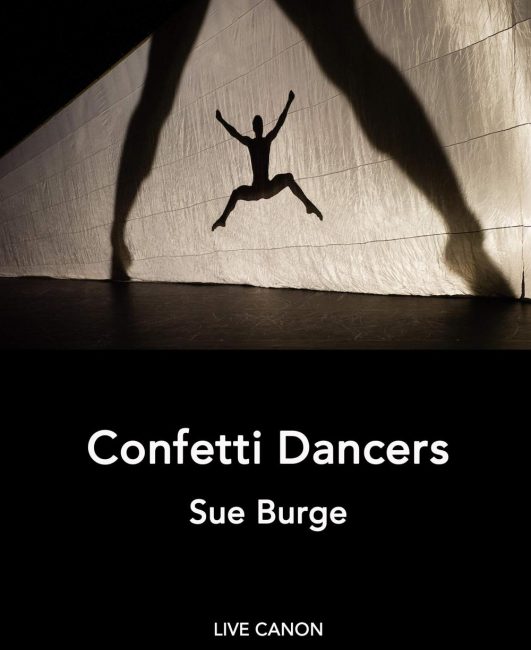
Confetti Dancers is a collection alive with rhythm and crystalline imagery. Sue weaves joy and fragility together in poems that reflect on life’s fleeting moments while celebrating its colour and energy.
Praise for Confetti Dancers
“The mythological and the very real collide in this startling and profoundly moving collection … These poems spoke to me and changed me a little — which is what a good collection should do.”
Julia Webb
Read sample poems from Confetti Dancers
Dead Friend as Imaginary Dog
You’ve lived longer in my mind
than in the flesh; less tangible
than the scratchy make-believe cat
I used to blame for everything

when my soundscape was the chittering
white noise typical of onelings -
like today’s lone walkers on the beach
who gossip to their loll-tongued dogs.

It’s called bemagination, this fuzzy line
between belief and imagination.
In another century you would be
household god, familiar, guardian angel.

So, my darling, I bemagine you as greyhound:
ribby dancer’s torso, burdened eyes,
prim toenails.  By my side.  Ready to listen.
Royal Academy of Dancing, Battersea – the 1980s
Autumn, and the sun’s tearing through the London grey.
I’m in the office, the coffee’s on, the blur
of comings and goings has begun, there are 50 people
in this building and I know all of them by name.
I’m nineteen, mind full of sex and fun and dance,
trying to secure the golfball on my typewriter
so it doesn’t break free when the letters whirr.
Someone’s pliéing in the kitchen while the kettle boils,
overhead the dancers jeté to a piano on repeat,
the corridors smell of rosin, sweaty practice clothes, feet.
My big glass ashtray’s choked with Camels, Marlboros,
scavenged Rothmans, paperclips.
Through the window I see my blue bike in the cobbled yard,
locked and leaning; John’s Morgan is nosing through the gates,
yellow as the tulips one of the heartbroken summer boys
(cheekbones like Rudi, eyes like Baryshnikov) gave me in July
the day after I tended his blistered bleeding feet.
There are Dames on every floor, gliding to the studios,
veiled in hairspray, Parma violets, Chanel.
The girls mouth “madame” then it’s feet on the bar
and pain to the rhythm of an ivory tipped cane.
Tempers are rising from the ground floor up, the lift pings,
I ignore the accusing filing cabinet, the exams to translate,
the accounts to tabulate, the Gestetner that makes me high,
the telexes to send to other hemispheres, and go walkabout,
check everyone’s still there, in their rightful place.
The disease is here but we don’t know it, no-one’s missing yet.
I line everyone up, like in an old school photograph,
turn my back for a minute and half of them are gone.
Don’t tell anyone about the well
says dad -
I peer under the lid
expect to see the moon
shining back at me like a golden cake
instead I’m leaning into
an endless darkness

ding dong bell I whisper
and I know my childhood
is down there now
throwing my words
back at me in a ghostly game of catch.

Over the years I watch dad strip
the warm guts from rooms
the hearths and tiles
the ancient copper in the corner
the pantry, the red floor that bled
when it was mopped.
Soon cottage became extension
became house.

At school my best friend
grips my hand, shouts
Riminy Rominy Ro!
And it’s down the well we go!
We jump smack!
onto the playground tarmac
squatting and weaving our bodies
and arms as if falling through the air.

I’m not allowed to tell her about the sinkhole
below the clean white shell
of our new lounge
the kind of shell you lift to your ear
and it tells you of nothing.

I can’t say I don’t like her new game
that she doesn’t know what having a well
in your life is really like - for she is a real girl
and I am just thin meniscus
terrified of breaking.

At night I sit
listening to the electric fire creak
as it cools and re-heats.
Alone on the Ercol sideboard,
glowing, is a bowl,
an almost perfect globe,
amber glass punctuated with bubbles
like the final exhalations
of trapped insects.

I fidget and twitch
invading my parents nightly game of statues.
They turn, brand me
with yet another imagined illness
St Vitus Dance, like your sister
hisses mum to dad.

I can never ask the question
my restlessness covers
dad, before you built us over the well,
did you fill it in?
The Saltwater Diaries
2020, Hedgehog Poetry Press, £7.00
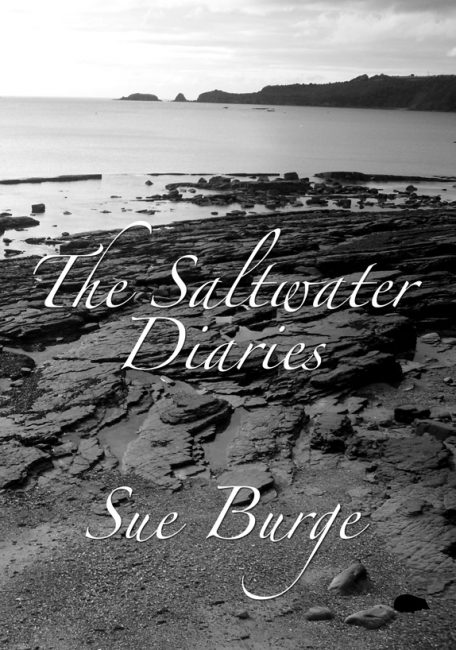
Written on the North Norfolk coast, The Saltwater Diaries captures seascapes, salt marshes, and the pull of the tide as metaphors for identity, belonging, and solitude. Intimate yet expansive, the collection reflects Sue’s ability to find meaning in natural rhythms and fleeting moments.
Praise for The Saltwater Diaries
“Richly atmospheric poems of snarl and fang with a dark, story-like quality … a pamphlet with ballast and intent that sails the warp and weft of the tides.”
Paul Stephenson
“A beautiful evocation of all that is special about the coast … a stunning collection of small pebbles that together can form mountains.”
Mark Davidson, Hedgehog Poetry Press
“Cinematic landscapes, crystalline images, heartfelt honesty & humility, linguistically-inventive lyricism.”
David Leo Sirois, Spoken World Online
Read sample poems from The Saltwater Diaries
The Unreliability of Clouds
There were no clouds where I grew up
for all good fairytales take place in the forest
between the shapeshifting shadows.
When I hear the word for the first time
it is too close to “clout” and “loud”.
I ask my unborn brother what it means,
instantly forgetting his answer.
One day a low cloud catches on a dead tree,
light as a cottonboll, as a wig.
This is the day my mother begins to die,
it takes her a lifetime to do so.
Gradually, I get to know them better.
Now I sleepwalk in the encyclopaedia of clouds –
full of moonshadows and ravens
defecating in the blackness.
I used to dream of being a weathergirl,
envying their power to move clouds
over land and sea.
Sometimes clouds appear like speech-bubbles,
broadcasting my untold thoughts.
I realise that each one is unique as a thumbprint,
though many are clichés.
Some are like sex, rumpled and knowing,
sashaying across the sky with sassy curves;
often they shadow my white clothes in passing
with an unbleachable darkness.
At day’s end the clouds look like bruises,
smell like vanilla.
Sea Glass
crushed sage. On my palm, grainy as a sugared almond,
you weigh less than a fulmar’s egg, more than a grey feather.
You could be three times older than me, or more,
but I like to think you are the echo of that glass
In The Kingdom of Shadows
2018, Live Canon, £10.00
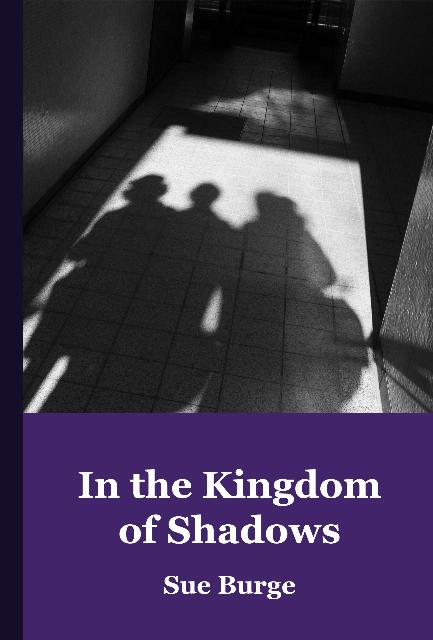
Sue’s debut collection is steeped in the language of cinema and shadow, exploring memory, history, and the flickering light of the screen. These poems draw on her deep knowledge of film and her gift for sharp visual imagery, creating work that is immediate, haunting, and richly atmospheric.
Praise for In the Kingdom of Shadows
“The mythological and the very real collide in this startling and profoundly moving collection … These poems spoke to me and changed me a little — which is what a good collection should do.”
Julia Webb
Read sample poems from In The Kingdom of Shadows
Spitting Distance
Perched on Hadrian’s Wall I arc
an apple core towards Scotland
to be picked to pips
by barbarian hordes
of rooks and crows.
At night, the rain on my tent
is the tramping feet
of long ago legionaries
marching in a Babel
of tongues, cosmopolitan
as any London street.
They carried dried cherries —
wrinkled, burgundy bursts
of southern sunshine,
spitting the stones
turned into a game of chance:
closest, highest, furthest.
I dream of an avenue
of blossom stretching
as far as Dover;
scenting their way home.
(first published in The North – Issue 52 Spring 2014)
I’m Not Wearing Chanel for the Radio
says Judy the week before she dies
as she pulls on her carnival mask,
clicks her heels night after night,
but home is never where she expects it to be
and she smokes till that voice, that whisky voice,
catches and gags, catches and gags,
her pitted lungs simmering with unsung songs,
her skinny arms,
zithered with old scars,
crawl their last as
she finds a corner
she can call her own,
to drink a final rainbow,
silencing all her somewheres
(first published in The Cannon’s Mouth – Issue 50 December 2013)
Bryce
I learn this quilt will contain
a hundred thousand unknown names

all forty-two of my facial muscles
try not to cry as I stitch the memory

of the day you showed me your arms
bejewelled with sarcoma,

how I felt the stutter of your
dancing heartbeat.

I re-imagine you flying home
to die in the Australian sun

while we mourned among
the cold grey bricks of Rotherhithe.

Then the others too were claimed,
one by one, long and slow and cruel

as purgatory.  I honour your name
in thread the colour of sunlight,

whispering all the news of all the years
you never knew me.
Lumière
2018, Hedgehog Poetry Press, £5.00
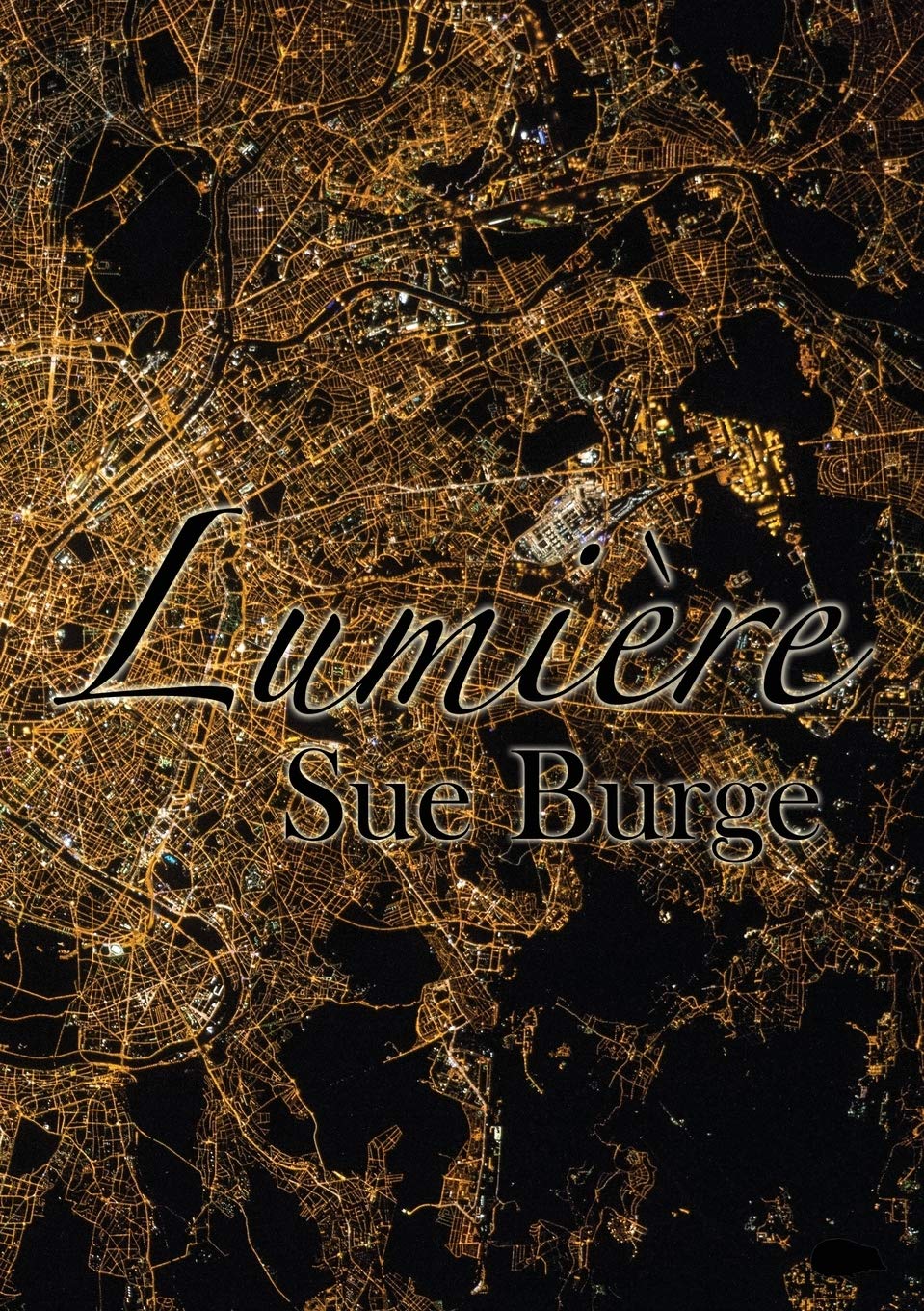
Lumière grew out of Sue’s time in Paris, supported by Arts Council England. This pamphlet explores her long and complex relationship with the city, drawing on its cinematic and literary legacy as well as her own lived experience. These poems are rich with imagery, light, and the shifting moods of Paris – by turns celebratory, reflective, and unsettling.
Praise for Lumière
“In her debut pamphlet, Sue Burge has captured the very essence of a Parisian dream … a confident and immensely impressive collection with an underlying humanity that richly rewards the reader.”
Mark Davidson, Hedgehog Poetry Press
“Sue Burge’s Lumière is wonderfully at ease in its own skin … she carries her knowledge of French cinema brilliantly and yet lightly.”
Penelope Shuttle
Read sample poems from Lumière
In Printemps Department Store
A sleety April shower drives me in,
past the soldiers on the wet street,
the bag searchers at the doors.
I escalate up six floors of opulence,
order a jug of chocolat onctueux
under a stained glass dome
higher than I can tilt my head.
It reminds me of Kirsten Dunst
in Marie Antoinette — surrounded
by pyramids of shoes like sugared almonds,
halls of mirrors reflecting an infinite catwalk,
cascades of champagne, and cake,
layered and extravagant as wigs.
This is how it began confides Marie as I take another sip
shopping lists get longer, longer
than the sum of my days…
The solace of silk and velvet, the heartflutter
of new shoes, the best pastries rotting
my weak-willed teeth, my play kingdom
spreading like mould at the end of Louis’ careful gardens,
unfinished, a whole age lost under a falling blade.
And perhaps this is how it will end for me,
a sudden shattering,
high heels whirling past like multi-coloured spines,
silk tearing and fluttering in a rainbow of rags;
the glass, royal blue, gold, terracotta, peacock,
raining down on my pretty neck.
(first published in The French Literary Review, Issue 26, October 2016)
Jean Gabin
It’s not an obsession, she assures her friends,
bedroom wallpaper sagging under the weight of his face.
She has never seen him in colour, pictures
hay blonde hair, eyes as blue as her new spring dress.
His face has lived a hundred lives; collar open,
jaunty casquette, worn trousers pulling at his lean bones.
She wants him to kill for her, lost in love’s whirlpool
like in Le Jour Se Leve as Arletty looks on.
None of his stories end well. One day she sees him
buying gauloises on the Rue de Charonne,
follows him back to a shuttered and geraniumed
apartment block; all day she remembers
how he smiled as she passed, how he was
both more and less than she imagined,
her body glowing like a miracle.
Occupation, Liberation, her bones surfacing,
blue dress at least a decade out of fashion,
she waits for him to return to the city
that gives him his only true voice.
The day he dies she cries herself to madness,
his funeral stately as a president’s,
his beautiful ashes, sinking.
Now she walks the streets, shows the world
his photo, creased and cracked to anonymity.
(first published in The French Literary Review, Issue 26, October 2016)